
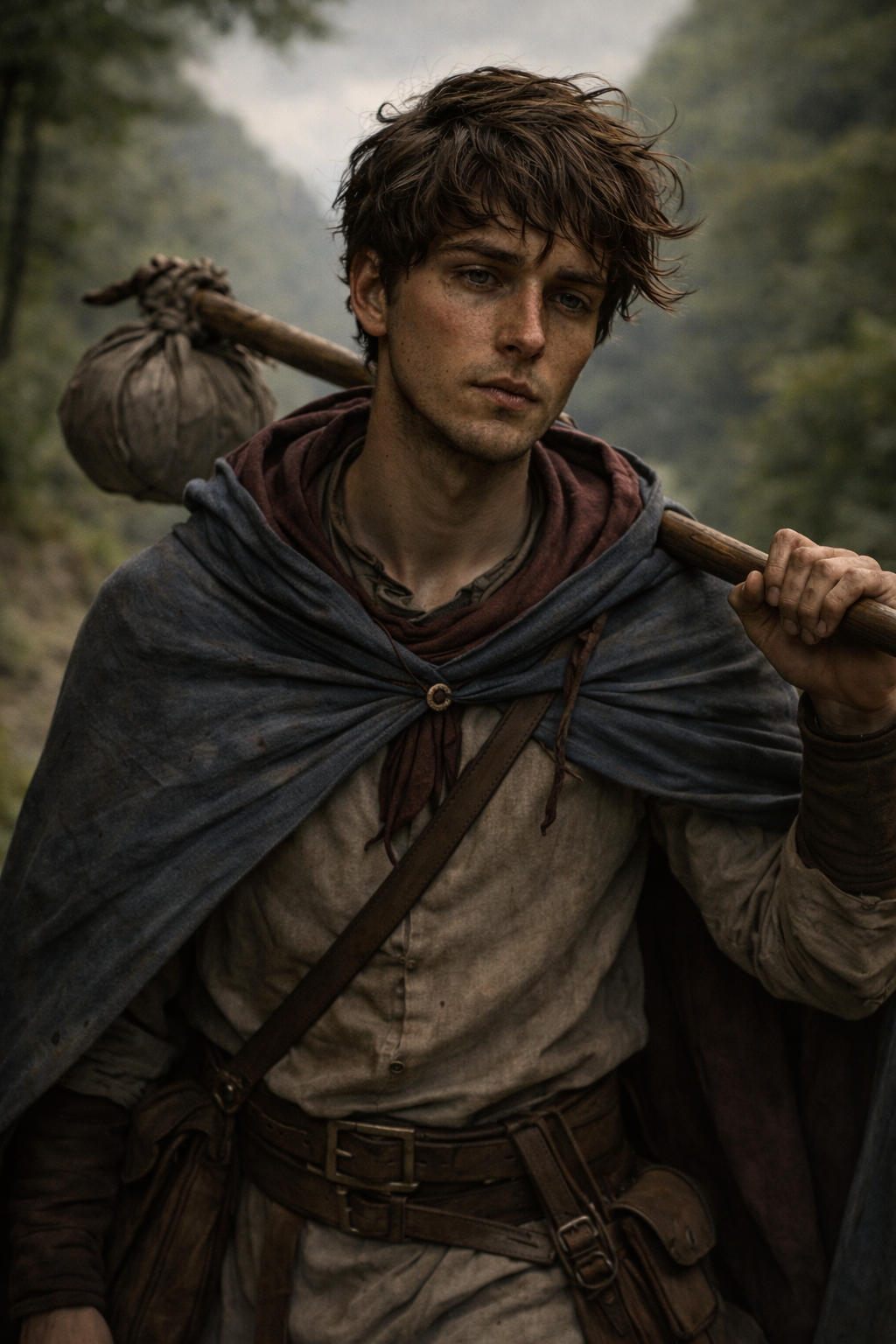
The Wanderer had not come here because he meant to.
At some point, the road had stopped being a road and had become a decision.
In recent days he had been walking without purpose and without haste. At first, a person goes somewhere because circumstances lead him there. Then because he grows accustomed to it. And eventually only the movement itself remains—no longer requiring explanation. The Wanderer woke early, when the air was still dense and cold and his thoughts had no time to assemble into coherent forms. He ate what remained, drank water, tightened the strap of his bag, and took the first step—always the same, as though repeating a memorized motion.
Today he woke beneath a tree that grew too close to the slope to offer reliable shelter, and was too ordinary to serve as a landmark. Such places are not considered dangerous—and for that very reason, people do not stay in them long. For a while the Wanderer lay there, looking into branches that did not shield him from the wind, thinking that the world as a whole was arranged in much the same way: it seemed stable, until you looked more closely.
He rose, brushed the dust from his clothes, and went on, as if continuing yesterday’s step.
The road was packed hard, almost to the density of stone. The dust stayed low, never rising above his ankles, as if it too knew the limits of what was allowed. Along the edges ran the traces of carts, the prints of hooves, old boot marks. Nothing fresh.
The world here had existed for a long time without the Wanderer.
At times he stopped—not from fatigue, but to listen. The road answered readily: somewhere wood creaked, somewhere metal struck metal with a dull sound, a short shout carried through the air. Everything happened independently of him. This lent the scene a strange calm. His presence did not alter the pattern. He was unnecessary—and there was no hostility in that.
The Wanderer carried only what could be carried. A worn bag over his shoulder, a knife, a length of rope, a few coins, a change of clothes, and objects whose purpose he sometimes forgot. This was not carelessness—rather, a trust in circumstance. If something was needed, it would appear. If not, then it could be done without.
By midday the road grew wider. Roads like this are not walked without reason. On them, one either returns—or leaves for a long time. The Wanderer did not choose his direction consciously. He went where the slope led.
***
He did not notice the border.
There were no gates, no guards, no marker bearing the name of the land. The air simply changed—grew denser, more attentive, as though space itself had allowed itself a moment to examine the newcomer. The Wanderer stopped without knowing why and looked around.
Hills. A trampled path. Stones. Grass. The smell of damp earth. Everything appeared ordinary—and yet inside him arose the sense that he had either arrived too late or come too early.
“Well then,” the Wanderer said aloud, testing the sound of his own voice.
The voice was the same. That eased him slightly.
After some time, walls appeared. Not at once—first a shadow, then projections of stone, and only then a gate darkened by age. It stood open. The guards remained calm, without any display of severity. Their gaze was quick, assessing, but not probing.
“Where from?”
“Far away.”
“And where to?”
“For now—here.”
The answers were accepted without clarification. Nothing was written down. No one delayed him.
“Go on.”
Inside, the city breathed with ordinary life. The square was occupied with work: sacks of grain were being unloaded, prices discussed without raised voices, children ran among adults without irritating anyone. The air smelled of bread, smoke, and warm food. A woman checked goods, marking something on a wooden tablet. Orders were given briefly and carried out at once.
People knew where they were going.
The Wanderer did not.
He crossed the square slowly, without lingering. No one looked at him longer than at any other passerby. This was not indifference—it was order. Everyone was engaged in their part of the whole, and there was no time for unnecessary questions.
Somewhere, decisions were being spoken of. Quietly, without debate. Simply as facts already settled.
The world was working.
***
The Wanderer stopped at the edge of the square, leaned against the cold stone, and set his bag beside him. He watched as movement did not cease for a single moment. Even pauses here were woven into the shared rhythm.
He noticed that no one hurried. People did not rush, yet they did not linger. Each step was justified by the one before it. This was an order that required no confirmation.
A man in heavy clothing passed by, accompanied by several others. They listened to him. Later—a woman overseeing supplies. People approached her with questions, but did not argue. All of it unfolded without tension, without pressure, as though the city had long since learned its own logic.
The Wanderer understood what unsettled him.
The world did not need him.
Not because it was hostile—but because it was self-sufficient.
He could vanish as quietly as he had appeared, and nothing would change. The thought was not painful. It was precise.
***
He remained standing as the sun began to lower. The day softened gradually, as though unwilling to disturb its own rhythm. The Wanderer felt something important slowly shift within him—from simple presence to an attention that would no longer retreat.
He was here.
But he was not necessary.
There was no humiliation in this. And no relief. Only a clarity that arrived without words. He could leave at any moment. He could stay. The world would object to neither.
And yet the Wanderer stayed. Not because he expected a place—only because the next road had not yet begun. He watched people pass, watched decisions being made without him, watched order held together by those who had lived within it for a long time and were already beginning to grow tired, though they had not yet admitted it.
This was not a story about the Wanderer.
This was a story about the world.
And he was only just entering it.
The world stood.
For now.