 No one entered this place by accident.
Even the path toward it was arranged so that the unnecessary would turn away before reaching the door. A narrow passage between two blank walls promised nothing of importance – no sign, no crowd, no familiar current of movement by which a city usually reveals where its need resides. The stone steps climbed upward not steeply, but stubbornly. They were worn not by time, but by constancy – worn not by everyone, but by those who truly needed to ascend.
There was no scent of food, smoke, horses, or damp market dust. The air held itself dry and steady, as if trained not to disperse without purpose.
The Wanderer did not notice the place at once. He sensed it first by the absence of the city’s ordinary breathing. Where elsewhere everything moved, argued, carried, counted, and hurried to catch up with itself, here the day seemed to hold its breath.
People passed the door without looking at it. The few who climbed the steps did so without haste and without speech, as though agreeing in advance to leave their voices outside. There was neither reverence nor fear in that agreement. Only an understanding that certain spaces do not welcome the loudest version of human presence.
He stopped at the entrance.
The door stood slightly ajar. Not invitingly. Not hospitably. Not as one opens a home expecting footsteps and conversation. It had simply been left unlatched. Visitors were neither awaited nor feared. Such places live not by invitation, but by the right to their own form.
He entered.
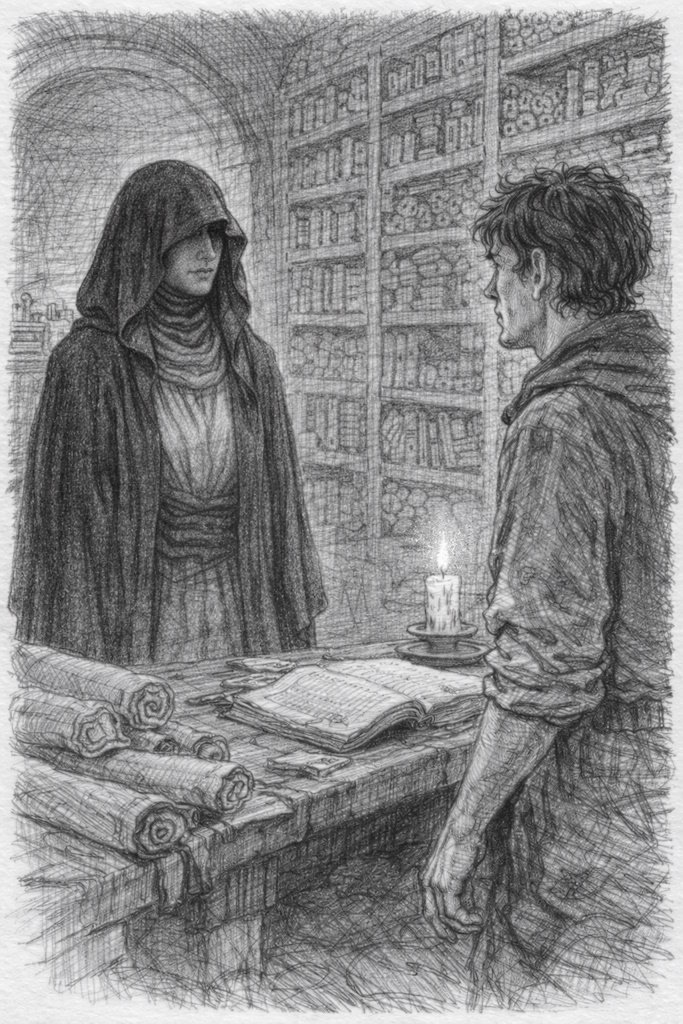
The room was larger than the narrow passage had suggested. High walls rose toward a dim ceiling from which an even light descended – not bright, yet sufficient for work. Shelves stretched from floor to the height where a ladder would be required. Scrolls, books, bundles of tablets, wooden boxes with dividers, narrow cases for single sheets – everything stood in order.
Not beautifully arranged. Correctly arranged.
There was no dust – not because it was diligently wiped away, but because nothing here had time to become neglected. Each object either served a purpose or waited within a clearly defined silence.
Several scribes worked at long tables. Quills scratched. Paper whispered. A page turned. A sheet slid closer. These sounds did not disturb the quiet; they composed it. No one lifted their head when the Wanderer entered. It was not disregard. Here attention belonged not to the newcomer, but to the task at hand.
He walked slowly between the tables, careful not to disturb another’s concentration with sleeve or glance. He immediately felt the difference between this place and the square. There, he had been unnecessary but almost invisible. The life of the city knew how not to waste energy on a passerby. Here, he was also unnecessary – but in another way. Like a stray breath among things whose value does not welcome unearned sight.
At the far end of the hall, at a separate desk, sat a woman.
She was impossible to overlook, yet difficult to define. Her clothing was as simple as the others’. She did not sit higher. She did not carry herself with deliberate rigidity. She did not surround herself with the cold importance by which some scholars compensate for uncertainty.
And yet the space around her existed differently.
Not emptier. Not quieter. More gathered.
As though the measure of the room converged, in some invisible ratio, toward her desk.
The scribes addressed her rarely. When they did, there was no haste. They did not chase her attention or rush her answer. They waited. Sometimes she responded immediately. Sometimes she reread a line. Sometimes she asked a brief clarifying question. Sometimes she said nothing – and that silence was enough for a page to be carried back and rewritten without resentment.
Not all authority loves speech. There is also a kind sustained by the fact that, in its presence, one begins to hear where one has no right to imprecision.
She was the Head of the Scribes.
The Wanderer stood aside and observed. He was interested not only in what was preserved here, but in how it was treated.
Nothing appeared secret in the cheap sense. Scrolls were not hidden in chests. Important records were not covered with heavy cloth. No one pretended that knowledge deepened merely through inaccessibility. And yet it was clear: not everything here was meant for every gaze.
Not because it was forbidden to see.
Because seeing and understanding are not the same thing – and the right to understanding is rarely granted together with curiosity.
He took a nearby scroll from the shelf.
A list of deliveries. Dates. Signatures. A clear sequence of things that could be counted, received, verified, presented if necessary. Another scroll described the allocation of labor for the coming days. A third concerned repairs to a warehouse roof. A fourth recorded an old dispute between two houses – already resolved, and therefore especially carefully documented.
Everything was comprehensible.
Too comprehensible.
He returned the scroll.
Here they knew not only what had happened. They knew the order in which events became the accepted version of themselves. Between occurrence and record stood a quiet hand – not deceitful, not hurried, but capable of deciding what of the living would receive the right to remain in the world’s memory.
He stepped closer.
“You are responsible for this place?” he asked, stopping at a distance that did not intrude.
The Head of the Scribes lifted her eyes.
Not surprised. Not guarded. Simply attentive – as one regards an unfamiliar word in a text that does not yet demand alarm, but cannot be ignored.
“For its order,” she replied.
“And for what is kept here?”
“For ensuring it can be found when needed.”
The answer was precise and spare. Spareness of this kind is not evasion; it is measure.
He paused.
“You know what is happening in the city?”
“Yes.”
“And what will happen?”
She regarded him a moment longer, as though weighing not whether to answer, but what form of answer he could bear.
“I know which decisions have already been discussed,” she said. “And which have not yet been spoken aloud, yet have begun to live as future form.”
Her voice was quiet. Not cold. Not softened. As one might read records of famine, death, debt, transfer of property – without adding personal tremor, without pretending that dry phrasing removes weight.
“Then you know how it ends,” he said.
“No,” she replied. “I know only where it is pulling.”
There was no ornamental wisdom in that. Only sobriety.
“And you do nothing?” he asked.
She closed the book before her, placed her palm upon its cover, restoring measure to both page and conversation.
“I do what is mine to do,” she said. “I preserve the course clearly enough that later it cannot pretend to have been something else.”
“But knowledge changes nothing if it remains silent.”
She inclined her head slightly – acknowledging the formulation, not the conclusion.
“It changes,” she said. “Just not always in time to save the particular day someone hopes to save.”
“Then it is too late,” he said.
“In time for memory,” she answered. “Not always in time for those who expect knowledge to become a cry.”
“You could warn them,” he said. “Those who decide.”
“They already know enough to decide.”
“Then warn those who will pay.”
“They would not want to know in advance.”
There was no contempt in her voice. Only recognition. Most people wish to measure danger only when knowing it still allows them to live unchanged.
“And you?” he asked. “Do you want to know in advance?”
Her gaze drifted briefly past him – to the shelves, the desks, the fine strips of light in which almost invisible dust turned slowly, to the scribes who continued working as though the world outside was not approaching something larger than routine adjustment.
“I want,” she said, “that when everything changes, enough truth remains that no one can later call it accident, misunderstanding, or natural order.”
Silence gathered.
“You understand that silence is also a choice?” he asked.
“Yes,” she replied. “Which is why I permit it only where speech would turn knowledge into noise before it becomes clarity.”
She stood.
The movement was simple. She approached one of the tables, took a bundle of sheets, scanned the top page, handed it back to a scribe.
“Rewrite. Check the dates. Remove the contradiction between the directive and the issuance mark.”
The scribe nodded without asking where the error lay.
“What is that about?” the Wanderer asked.
“Allocation of responsibility.”
“Formally?”
“Formally – order.”
“And in essence?”
A faint pause.
“Who will be considered responsible when what is now called measure begins to require the naming of the guilty.”
The words sounded different. Not abstract now, but like a lifted edge of fabric revealing what is usually named later, and otherwise.
“These decisions have not been announced?”
“Not to everyone.”
“But they are already in effect?”
“They always begin acting before they acquire their final name.”
There was something almost cold in that precision. Knowledge here was not power in the ordinary sense. It did not intervene. It did not correct. It preserved witness.
“You are not afraid they will say you could have stopped it?” he asked.
“They will say so,” she replied.
“And?”
“They will be right in their way.”
No apology. No defense.
The quills scratched. Pages whispered. Dates and numbers murmured beneath steady hands turning the movement of time into retained form.
“Why do you do this?” he asked quietly. “If you know, and remain silent?”
She looked at him long, as though measuring whether he possessed enough inner quiet to bear the answer without immediate protest.
“Because when the world begins to break,” she said, “what disappears first is not bread, nor law. What disappears first is clarity about how it arrived at that point.”
He did not look away.
“And you wish to preserve it.”
“I wish it to remain possible,” she replied. “Memory is not for comfort. It is so that form does not one day decide it alone was truth.”
The words lingered.
“Do you consider this right?” he asked.
She did not answer at once.
“No,” she said finally. “I consider it insufficient. But sometimes the world is prevented from total falsehood precisely by what is insufficient.”
It was not the answer of a victor, nor of a sage. It was the answer of someone who had long abandoned the beauty of completeness and learned to work with what moral remainder had not yet been reduced to zero.
Outside, the noise of the city sounded different. Not louder – clearer.
The city lived.
But somewhere within it, a version of events was already assembling – the one that would one day be called truth.
And the struggle ahead was not only for bread, house, debt, and right.
It was also for what would remain recognized as having happened.