People did not come to this place to resolve something.
They came when they wanted to be certain that the world was still where it belonged. The stone building stood slightly apart from the main streets—not hidden, yet not imposing itself. It was neither avoided nor sought out deliberately. It simply was. Like a landmark that needs no path because it is always nearby.
By morning, people began to gather in small groups. Unhurried. Without conversation along the way. Those who arrived together slowed before the entrance, as if adjusting themselves to a shared rhythm. No one hurried to claim a better seat—there were no better seats here.
Inside, it smelled of stone and old wood. Candles burned evenly, without smoke. They were not lit for beauty—this was simply how it was done. The hall was plain: rows of benches, a raised platform at the front, nothing unnecessary. No one came here seeking impressions. They came seeking confirmation.
The Wanderer entered with the others. He did not know why he had come, but he understood why he stayed. After days filled with decisions, knowledge, and order, this place offered something else—an explanation that did not require choosing.
***
When everyone had taken their seats, no signal was given to begin. At some point, the conversations simply faded. Not all at once, but close enough not to disturb the silence.
The Priest stepped forward.
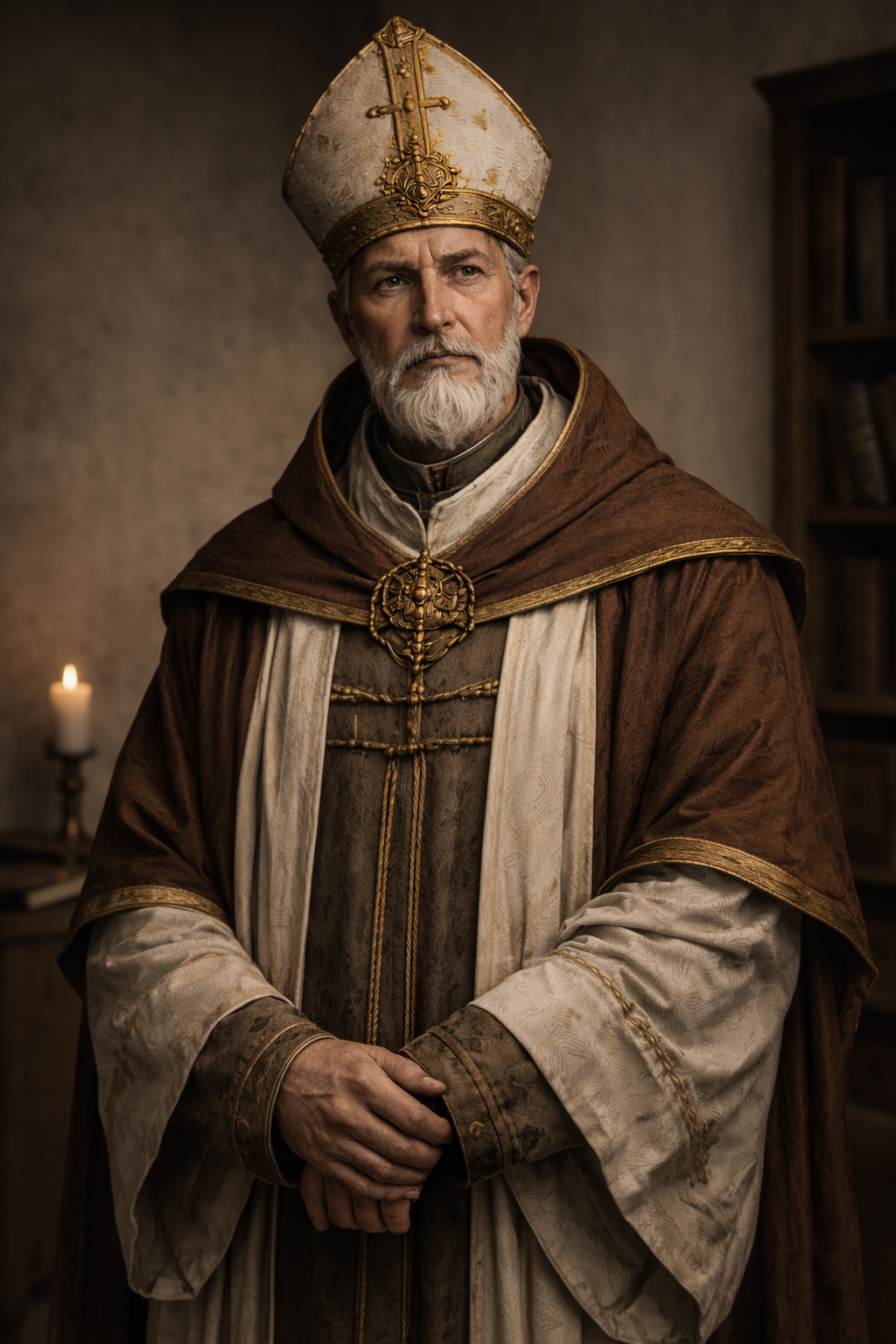
His clothing was immediately distinct.
Not by richness—by form.
A dark garment, clean and carefully preserved, fell evenly, without folds. A head covering concealed his hair and made his face appear sterner than it truly was.
He carried no objects that demanded attention. He did not raise his voice to be heard. Listening already filled the room.
“We have gathered as we have gathered before,” he said calmly. “Not because something new has occurred. But because nothing should be new.”
There was no visible reaction. No nods. No exchanged glances. These words were known. That was their strength.
“Order rests not only on decisions,” the Priest continued. “It rests on memory. On what has already been tested. On what has endured time.”
He spoke slowly, pausing not for effect, but for precision. Each word settled into a place that already existed.
“We do this not because it is the only way.
We do this because it was done before us.”
The hall was quiet. Not tense—calm.
***
The Priest let his gaze move across the hall. He did not seek approval. He sought understanding—and found it without effort.
“You ask why we do not change order every time doubt arises,” he said. “Because doubt is a poor adviser. It always arrives before understanding.”
He did not say, you are wrong. He said, we have known this for a long time.
“The world has survived much. Not because of new ideas, but because not every idea was accepted.”
Someone shifted slightly on a bench. Someone drew a deeper breath. The movements were nearly imperceptible, but the Wanderer noticed them. Here, no one argued. Here, agreement came first.
“Tradition is not a prohibition,” the Priest said. “It is a boundary. It shows where one may go without destroying what holds us together.”
He paused.
“If every time we ask why,” he continued, “one day we will no longer be able to answer because.”
***
The Wanderer listened attentively. Not because he agreed—but because he understood the logic. There was no foolishness in the Priest’s words. No falsehood. There was experience, built through years of repetition.
He looked around. The people nearby appeared calm. Certain. This explanation gave them a footing that decisions and commands did not. Here, understanding was not required—memory was enough.
And yet something did not align.
The Wanderer noticed that the Priest never once said when tradition ceased to be protection and became an obstacle. He spoke of the past as though it could not be mistaken.
***
When the address came to an end, no one applauded. That was unnecessary. People began to rise from the benches, preparing to leave, when the Wanderer stepped forward.
The movement was small, but it was noticed. The hall fell silent again.
“May I ask something?” he said.
The Priest looked at him calmly. Not surprised. Not irritated.
“You may,” he replied.
“You say this is how it is done,” the Wanderer said. “And that it has been tested by time.”
“Yes.”
“And if time was wrong?”
The question was not loud. But it changed the silence. It became different—not empty, but tense.
The Priest did not answer immediately. He studied the Wanderer closely, as if deciding which answer was appropriate here.
“Time is never wrong,” he said at last. “It filters.”
“What?”
“That which cannot endure,” the Priest replied. “And leaves what can be repeated.”
The Wanderer nodded, but did not step back.
“And if something endured not because it was right,” he asked, “but because people grew used to it?”
Someone in the hall cleared their throat. Someone else looked away.
***
The Priest folded his hands before him. His voice remained even.
“Habit is not weakness,” he said. “It is a form of survival.”
“Even if it no longer helps?”
“It helps keep people together,” the Priest replied. “And that matters more than individual errors.”
“And if the cost is too high?” the Wanderer asked.
The Priest looked at him for a long moment. Longer than before.
“The cost is always high,” he said. “It is simply not always visible at once.”
He paused.
“We do not choose between right and wrong,” he continued. “We choose between preservation and rupture.”
***
People began to leave. Slowly. Without discussion. This conversation did not require commentary. Each had heard exactly as much as they were prepared to hear.
The Wanderer remained standing. He felt that the question had not been dismissed—it had been postponed.
The Priest stepped closer.
“You are searching for answers,” he said quietly.
“I am searching for the boundary,” the Wanderer replied.
“Boundaries become visible only after they are crossed,” the Priest said. “And not to everyone.”
The Wanderer did not respond.
When he stepped outside, the day continued as usual. People went about their business. The city lived.
The world was working.